.png)
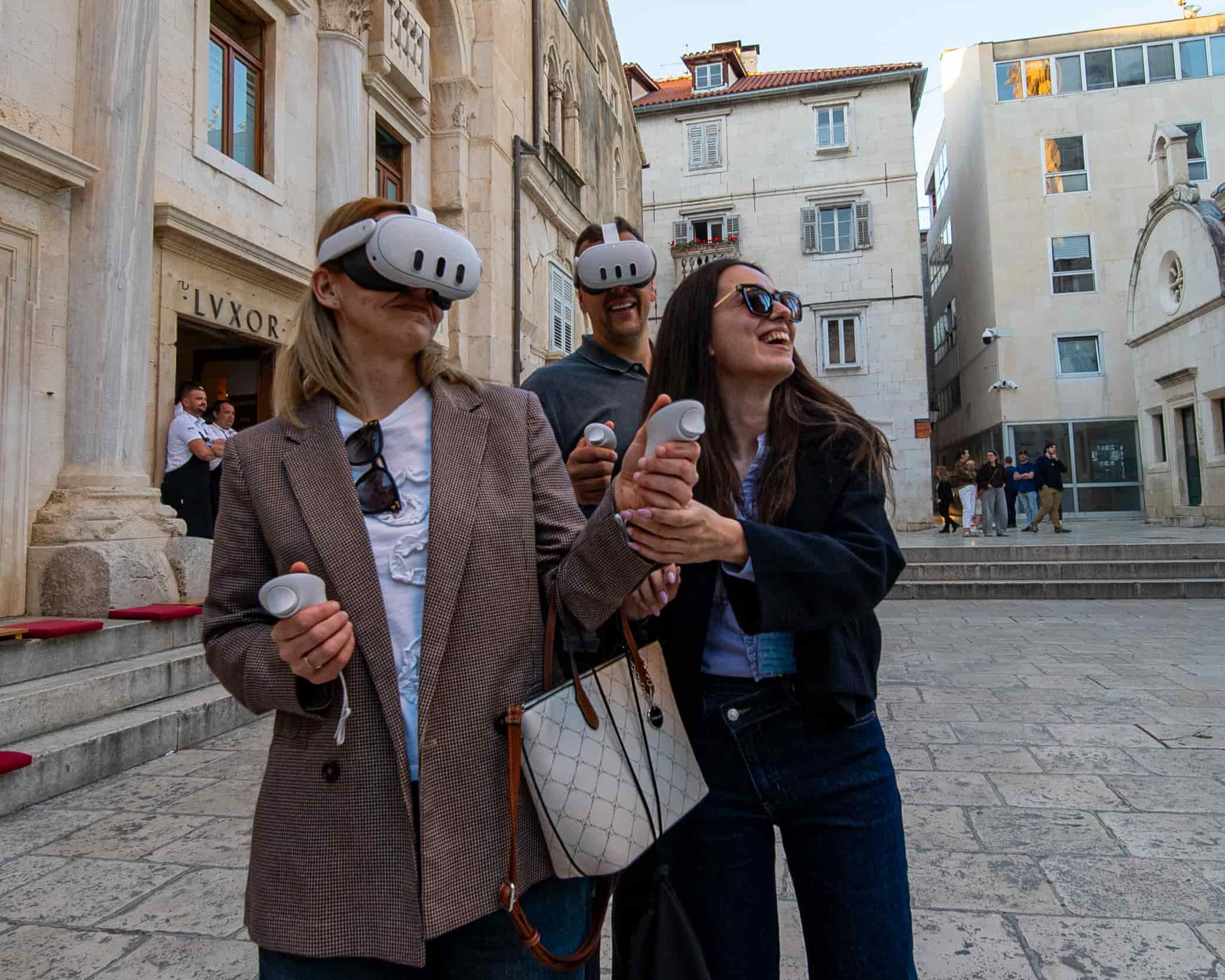
You're standing in a 1,700-year-old Roman courtyard. The stones beneath your feet are real. The air is Mediterranean. And through the headset you're wearing, you can see exactly what this place looked like the day it was built — temple facade intact, imperial statues in their niches, the Peristyle alive with Roman ceremony rather than café tables.
That's a VR walking tour. And it's one of the most genuinely new things to happen to cultural tourism in years.
This guide explains what VR walking tours are, how the technology works, what to expect on one, and whether they're right for you.
A VR walking tour (also called an augmented reality walking tour or mixed reality tour) is a guided tour of a real physical location that uses a headset to overlay digital reconstructions of historical structures onto what you're seeing in front of you.
The key distinction from a standard VR experience: you're not sitting still in a virtual world. You're walking through a real place — a Roman palace, a medieval city, an ancient battlefield — while the headset adds a layer of historical visual information over your actual surroundings.
When you look at a ruined arch, you see it restored. When you stand in an empty space where a building once stood, you see the building. When you look at walls that were once painted, you see the paint.
The tour guide — a real person walking with you — provides the historical context. The headset provides the visuals. The actual location provides the physical experience of being there.
Modern VR walking tours typically use what's called passthrough augmented reality — a technology that's become viable at consumer scale only in the past few years.
Traditional VR headsets replace your vision entirely with a virtual environment. You're blind to the real world while wearing them — which is why you can only use them in a controlled space.
Passthrough AR works differently. The headset has external cameras that film the real world in real time and display that footage inside the headset — so you see the actual world around you, with a very slight delay and processing. Digital elements are then rendered and composited into that real-world view, appearing to exist in the actual physical space in front of you.
The result is that you can walk through a real place, see the real ground beneath your feet, navigate real stairs and obstacles, and interact with your physical environment — while also seeing 3D digital reconstructions overlaid onto it.
The Time Walk tour uses Meta Quest 3 headsets — currently the best consumer-grade device for mixed reality applications. The Quest 3's colour passthrough cameras provide a significantly clearer and more accurate real-world view than previous generations, making the AR overlay more convincing and the experience more comfortable.
The headset is untethered (no cables), lightweight, and designed for mobile use — which is what makes walking tours feasible. You can move freely, look in any direction, and navigate a real outdoor environment without physical constraints.
The digital content — the reconstructed Roman palace, the temple facades, the throne room as it was — is built by historians and 3D artists working from archaeological evidence. This includes:
The reconstruction is not guesswork. It's an evidence-based interpretation of what the historical record says was there, rendered in 3D and positioned precisely over the actual physical remains.
A standard walking tour gives you an expert guide who explains what you're looking at. That's valuable — a good guide transforms a walk through old stones into a coherent historical narrative.
A VR walking tour does everything a standard tour does, and adds the visual dimension that standard tours can't provide: showing you what things looked like, not just telling you.
Consider the difference between:
Standard tour: "You're standing in what was once the emperor's throne room. The walls would have been covered in marble veneer and elaborate painted decoration. The throne was positioned here, facing the entrance. Diocletian would have received visitors while seated, a deliberate display of imperial power."
VR walking tour: Same explanation, but as the guide speaks, you see the marble walls appear around you, the painted ceilings materialise above you, and a throne takes form at the far end of the room — all while you're standing in the actual space where it happened.
The first is informative. The second is memorable.
VR walking tours are not a replacement for:
They're an addition to those experiences, not a substitute for them.
The Time Walk tour is 80 minutes long and covers Diocletian's Palace in Split. Here's what the experience looks like:
You meet your guide at the Peristyle — the grand central courtyard of the palace. The group is small (typically under 15 people), which allows for genuine conversation and personalised historical explanation.
Your guide gives you a brief orientation to the headset — how to put it on, how to look around, what you'll be seeing. This takes only a few minutes. The technology is designed to be intuitive.
You walk through the actual streets and spaces of Diocletian's Palace with the headset on, stopping at key locations where the AR overlay is activated. At each stop, the guide provides historical context while the headset shows you the reconstructed space.
Locations typically include:
At each location, you can look around freely — the AR reconstruction fills your field of view. You're encouraged to look up, look sideways, explore the space visually while the guide explains what you're seeing.
The tour ends at the Peristyle. Your guide will typically take questions. Most people find that the experience significantly reframes what they subsequently see in the palace on their own — having seen the original structure, the layers of medieval and later construction become much more legible.
If you're genuinely interested in Roman history, Byzantine history, or medieval Dalmatia, a VR walking tour provides a depth of visual and historical information that no other format matches. The combination of expert narration and visual reconstruction is uniquely effective for understanding a complex historical site.
Children who might disengage from a standard guided tour often respond very differently to VR. The visual immediacy of seeing a palace materialise around you is engaging regardless of age. The Time Walk tour works well for children over approximately 8 years old.
The spatial intelligence provided by seeing a Roman building in its original configuration — proportions, volumes, material finishes — is genuinely useful for architects, designers, and urban planners interested in the history of the built environment.
If you've been to Split before and walked through the palace as a standard tourist, a VR tour offers a fundamentally different experience. You already know the physical space; the VR layer adds the historical dimension you couldn't access before.
An 80-minute guided VR tour provides more historical context and visual understanding than most visitors acquire in a full day of independent exploration. If you have only one day in Split, this is an efficient way to get depth.
Is it comfortable to wear a headset while walking?
The Meta Quest 3 is designed for extended wear. Most people find it comfortable for an 80-minute tour. The weight is distributed across the head rather than concentrated on the nose (as with older headsets). If you wear glasses, the headset accommodates them.
Do you feel motion sick?
Motion sickness in VR typically occurs when your visual field suggests movement that your body isn't experiencing — you're sitting still but appear to be moving. VR walking tours minimise this because you are actually moving, and your visual and physical experience are aligned. Motion sickness is uncommon on walking tours for this reason.
What if I'm not good with technology?
The headset is simpler to operate than a smartphone. You put it on, you look around, you walk. There are no controls to learn. The guide handles everything.
Can I still see the real world?
Yes. The passthrough cameras show you the real world at all times. The AR overlay appears within your view, but you can always see the actual ground, the actual people around you, and the actual physical environment. You won't trip on the cobblestones.
How large are the groups?
Time Walk keeps groups small — typically under 15 people. This allows the guide to engage with everyone and for the tour to feel personal rather than industrial.
Not every historical site lends itself to VR reconstruction. Split's Diocletian's Palace is unusual for several reasons:
The structure is largely intact. The walls, the gates, the basic layout — all of this is still present. The VR overlay has real physical structure to attach to, which makes the reconstruction more spatially convincing.
The site is continuously inhabited. The contrast between the Roman original and what's there now is particularly stark and interesting. Seeing the throne room materialise inside what is currently someone's apartment building is a peculiarly vivid experience.
The archaeological record is well-documented. Robert Adam's 18th-century survey, combined with 20th-century excavation and decades of academic research, means the reconstruction has a solid evidential basis.
The setting is spectacular. You're doing this in a real Mediterranean city, on real Roman stones, with the Adriatic a few hundred metres away. The combination of the physical experience and the visual overlay is greater than either alone.
Ready to experience Diocletian's Palace as it looked in 305 AD? Book your Time Walk VR tour in Split.