.png)
He was born poor in a Dalmatian backwater. He rose through the Roman military during the worst political crisis in the empire's history. He survived a period when emperors died on average every two years. He restructured Rome itself — reinventing how the empire was governed for the next two centuries. He persecuted Christians on a scale Rome had never seen before. And then, when no Roman emperor had ever done so before him, he voluntarily walked away from power, retired to a palace he had built on the Adriatic coast, and reportedly spent his remaining years growing cabbages.
This is the story of Diocletian — one of the most consequential, contradictory, and personally fascinating figures in Roman history. The man who built the structure that became modern Split.
Diocletian was born around 244 AD in or near Salona, the Roman provincial capital of Dalmatia. Salona stood a few kilometres inland from the site where, sixty years later, he would build his retirement palace. The ruins of Salona are still visible today, near Solin.
His origins were modest. Ancient sources describe his father as either a scribe (a clerk or copyist) or a freed slave who had worked for a Roman senator named Anullinus. Either way, the boy who would become emperor was not born into wealth, power, or imperial blood. In the rigid hierarchies of Roman society, his rise is one of the most dramatic in the empire's 1,200-year history.
His birth name was probably Diocles — a Greek-derived name common in the Balkan provinces. He took the Latin name Diocletianus only after his elevation to emperor.
There is almost nothing reliable in the historical record about his childhood. Like many Roman provincials of his era, he likely joined the army as a young man. The Roman military was the great social leveller of the empire — a place where talent, brutality, and luck could lift a man from the provinces to the centre of power.
To understand Diocletian's career, you have to understand the world he stepped into.
The Roman Empire in the 3rd century AD was in a state of near-permanent crisis. Historians call this period the Crisis of the Third Century (235–284 AD). In those fifty years, the empire was ruled by more than fifty claimants to the throne, most of whom died violently. The average reign was approximately two years.
The crisis had multiple causes: invasions by Germanic and Persian forces, plague, hyperinflation, the collapse of trade networks, separatist breakaway states in Gaul and the East, and a Roman political culture that had become incapable of orderly succession. Emperors were proclaimed by the military, ruled briefly, and were typically killed by their own troops or by rival claimants.
Diocletian came of age in this chaos. He survived it. By 282 AD, he had risen to the rank of commander of the imperial bodyguard under Emperor Numerian.
In November 284 AD, Numerian died in suspicious circumstances during a campaign against Persia. According to ancient sources, his body was discovered in his sealed travel litter, decomposing — having apparently been dead for some days while his praetorian prefect Aper concealed the death and gave orders in his name.
The army assembled in council. Diocletian — then aged about forty — accused Aper of murder and personally killed him with a sword in front of the troops. The army proclaimed Diocletian emperor on the spot.
The following year, he defeated and killed Carinus — the late Numerian's brother and rival claimant — in a battle in the Balkans. By the spring of 285 AD, Diocletian was sole emperor of Rome.
He inherited a broken empire.
Diocletian's central insight was that the Roman Empire had become too large, too complex, and too unstable for a single ruler to govern alone. Every previous emperor had tried; every previous emperor had eventually failed.
His solution was unprecedented: split the empire into manageable parts, each with its own emperor.
In 285 AD, he appointed Maximian as co-emperor (Augustus) in the West, while Diocletian himself ruled the East. The two men were notionally equal in rank, though Diocletian was the senior partner.
In 293 AD, he expanded the system. Each Augustus appointed a junior emperor (Caesar):
This was the Tetrarchy — the rule of four. The empire was divided into four administrative regions, each with its own court, military, and bureaucracy. The Caesars were also designated heirs: when an Augustus died or retired, his Caesar would be promoted, and a new Caesar would be appointed beneath him.
It was a radical restructuring of Roman imperial government — and remarkably, it worked. For more than twenty years, the empire enjoyed political stability it had not seen in a century. The Tetrarchy halted the spiral of usurpations and civil wars that had nearly destroyed Rome.
Diocletian also reformed:
These reforms were so substantial that some historians describe Diocletian as effectively the founder of a new state — the Late Roman or proto-Byzantine empire — rather than a reformer of the old one.
Diocletian's legacy is permanently complicated by the Great Persecution of Christians, launched in 303 AD.
The persecution unfolded in waves. In February 303 AD, an imperial edict ordered:
A second edict followed, ordering the arrest of Christian clergy. A third offered amnesty to clergy who sacrificed to Roman gods. A fourth — the most severe — extended the requirement to sacrifice to all Christians, on penalty of imprisonment, torture, or execution.
The persecution lasted, in various forms and intensities across different parts of the empire, until 311 AD. It was the most systematic anti-Christian campaign in Roman history.
The historical record on Diocletian's personal role is debated. Some sources suggest his Caesar Galerius was the driving force behind the persecution, with Diocletian initially reluctant. Other accounts hold Diocletian personally responsible. What is clear is that Diocletian was deeply religiously conservative, committed to traditional Roman polytheism, and viewed the spread of Christianity as a threat to the religious unity that he believed underpinned Roman order.
The persecution did not work. Christianity not only survived but emerged stronger. Within a generation, Constantine — the son of Diocletian's western Caesar Constantius Chlorus — would issue the Edict of Milan (313 AD) granting Christians religious freedom, and within Constantine's lifetime Christianity would become favoured by the imperial state.
There is a sharp historical irony here. Diocletian built his retirement palace with an octagonal mausoleum at its heart — intended for his own burial as a deified emperor. Within a few centuries, that mausoleum had been converted into a Christian cathedral dedicated to Saint Domnius, a bishop whom Diocletian had personally martyred in 304 AD as part of the Great Persecution.
The man who tried to destroy Christianity was buried in a building that became one of the world's oldest cathedrals — dedicated to one of his victims.
If you want to walk inside this mausoleum-turned-cathedral and understand what it was, our history of Diocletian's Palace covers the full story of how the building changed function across 1,700 years.
In the late 290s AD, Diocletian began building a palace on the Adriatic coast, near his birthplace at Salona. Construction took approximately ten years. It was completed around 305 AD.
The site was carefully chosen: close to home, defensible (located on a small peninsula), and pleasant — protected from the worst weather by surrounding hills, facing south to the sea.
The palace was not a single building but a fortified complex covering approximately 3 hectares (30,000 square metres). It was designed as both an imperial residence and a military garrison, with high walls (up to 26 metres on the northern side), four gates oriented to the cardinal directions, and an internal layout based on a Roman military camp (castrum).
The southern half of the complex contained Diocletian's private apartments, opening onto a colonnaded gallery overlooking the Adriatic. The northern half contained quarters for soldiers, servants, and administration. Two main streets (the Cardo and Decumanus) crossed at the centre, dividing the complex into four quadrants.
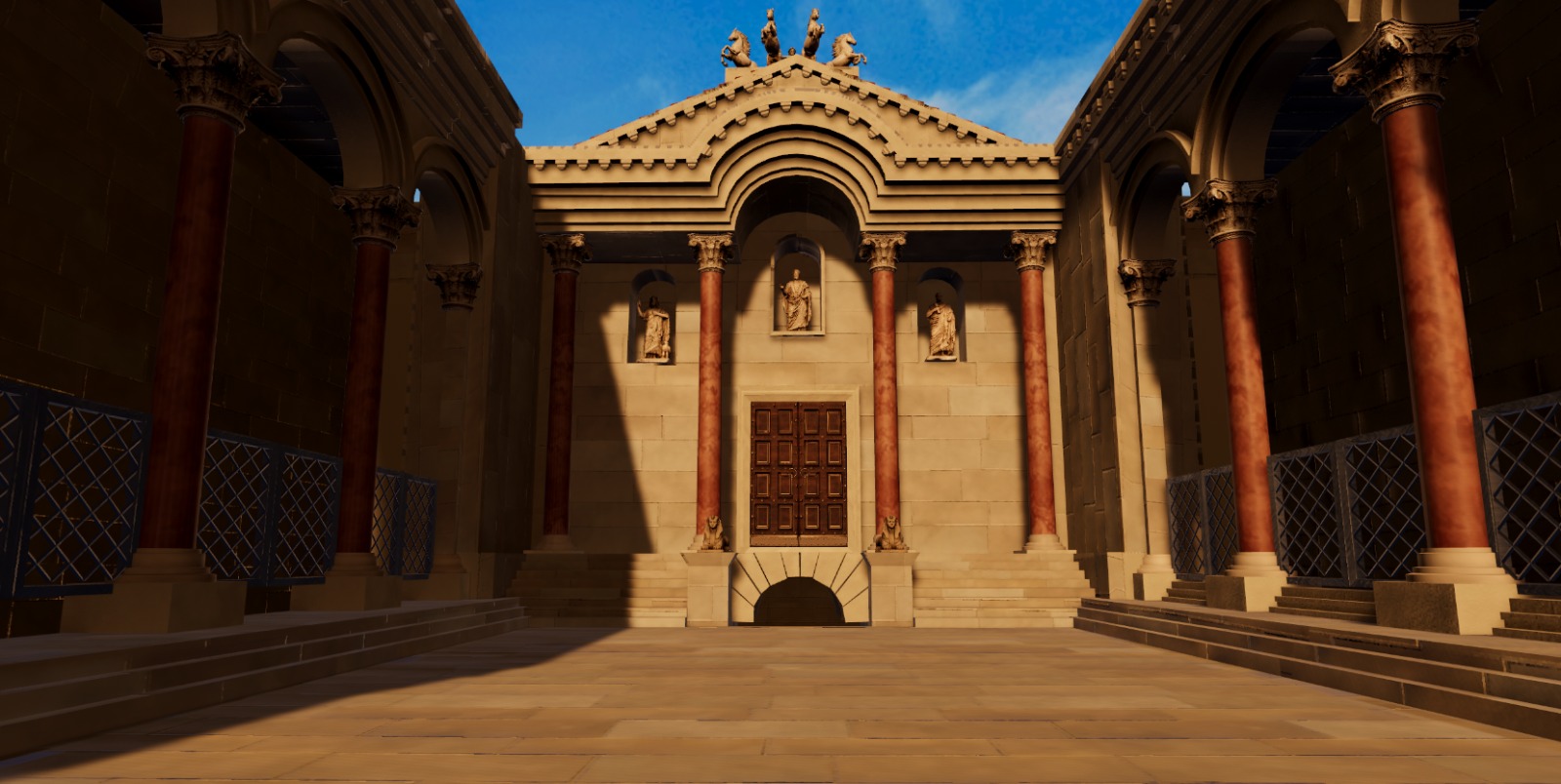
At the heart of the southern half stood the Peristyle — a colonnaded ceremonial courtyard. On its western side was the Temple of Jupiter (later converted into a baptistery). On its eastern side was the octagonal mausoleum intended for Diocletian's burial. Through an archway to the south was the Vestibule — a circular domed anteroom leading into the imperial apartments.
The building stone came mostly from the island of Brač — the same white limestone that would later be used in countless monuments across the Mediterranean and (according to one popular but disputed claim) in the construction of the White House in Washington DC. Granite columns were imported from Egypt. Marble came from Greece.
Diocletian's Palace remains one of the best-preserved Roman imperial residences in the world — partly because, after Diocletian's death, the palace was never abandoned. Refugees from nearby Salona moved inside its walls in the 7th century, and the palace has been continuously inhabited ever since. Today, around 3,000 people live within its walls. For the full story of the building across 1,700 years, see our complete history of Diocletian's Palace.
On 1 May 305 AD, Diocletian did something no Roman emperor had ever done: he resigned.
In a public ceremony at Nicomedia (modern Izmit, Turkey), he removed his imperial purple robe and handed power to his Caesar Galerius. His co-emperor Maximian, who had agreed reluctantly, simultaneously abdicated in Milan in favour of Constantius Chlorus.
The Tetrarchy was meant to ensure orderly succession. In theory, the two new Augusti would each appoint a new Caesar, and the system would continue indefinitely. In practice, it collapsed almost immediately into civil war.
Diocletian retired to his completed palace at Split. He was approximately 60 years old.
A famous anecdote — preserved in the historical record — captures Diocletian's view of his retirement. When his former colleagues, embroiled in the civil wars that followed his abdication, urged him to return to power, he is reported to have replied:
"If you could show the cabbage that I planted with my own hands to your emperor, he definitely wouldn't suggest that I replace the peace and happiness of this place with the storms of a never-satisfied greed."
He spent his final years in the palace, gardening, receiving occasional visitors, and watching the imperial system he had created fracture from a safe distance.
Ancient sources are unclear on the precise date of Diocletian's death. Most historians place it between 311 and 313 AD. He would have been approximately 66 to 68 years old.
The cause of death is equally uncertain. Some sources suggest natural causes — old age, perhaps stomach illness. Others suggest he committed suicide by self-starvation, reportedly in response to the Christian-favouring policies of his successors, the humiliation of Maximian's death, and the destruction of his political legacy.
What is clear is that he died in his palace at Split and was buried in the mausoleum he had built for himself. His tomb was probably destroyed in the 7th century when the building was converted into a Christian cathedral; no certain physical remains of Diocletian survive.
His wife Prisca and daughter Valeria — both reportedly sympathetic to Christianity — were caught up in the political turmoil following Diocletian's abdication. Both were executed around 314–315 AD by Licinius, one of Diocletian's successors. The line of the man who tried to destroy Christianity ended within a decade of his death.
Diocletian's reputation has fluctuated dramatically across the centuries.
To Christian historians, particularly Lactantius and Eusebius writing in the generation after his death, he was a tyrant and a persecutor — a man whose name became synonymous with cruelty toward the faithful.
To later Roman historians, he was the restorer of the empire — the man who pulled Rome back from the brink of dissolution and gave it another two centuries of life.
To Byzantine historians, he was effectively the founder of their state — the architect of the administrative, military, and economic structures that defined the Eastern Roman Empire.
To modern historians, he is one of the most consequential figures in late antiquity — flawed, brutal in his persecution of Christians, but extraordinarily effective in his political restructuring of a collapsing empire.
What survives most vividly today is not his political reforms or his religious policies. It is his palace at Split — a building that has outlived the empire that produced it by more than 1,500 years, and that remains one of the best places in the world to physically encounter the late Roman world. If you're planning to visit, our one-day Split itinerary walks you through the palace from sunrise to evening.
The single best place to encounter Diocletian today is, unsurprisingly, his palace. The complex he built is now the historic centre of Split — a UNESCO World Heritage Site since 1979 and one of the most extraordinary continuously-inhabited Roman monuments in existence. For a deeper look at what makes the palace unique among Roman sites, see our guide to the best walking tours in Split.
Within the palace:
For visitors who want to understand what these spaces looked like when Diocletian lived in them — not as ruins or medieval adaptations, but as the imperial complex it originally was — the Time Walk VR walking tour reconstructs the palace as it stood in 305 AD, the year Diocletian moved in. Using Meta Quest 3 headsets at two key locations (the Golden Gate and the Peristyle), the tour shows you the palace exactly as Diocletian saw it.
You can book your Time Walk tour here.
For broader visitor planning, our one-day Split itinerary places the VR tour at midday — after a self-guided walk through the palace at sunrise — and builds the rest of the day around the historical centre Diocletian created. For more ideas, see our roundup of things to do in Split, Croatia.
That depends on the framework. Politically and administratively, he was one of Rome's most effective emperors — restoring stability after fifty years of crisis and creating institutions that lasted for centuries. Morally, his persecution of Christians was a major and lasting black mark. Most modern historians regard him as transformative but flawed: a brilliant reformer with serious crimes attached to his record.
The cabbage anecdote is preserved in ancient sources and is plausible but cannot be independently verified. Whether or not he literally gardened, the underlying claim — that he chose private retirement over a return to power — is well-attested. He is the first Roman emperor known to have voluntarily abdicated and stayed out of politics.
The reasons are debated. Diocletian was religiously conservative and viewed traditional Roman polytheism as essential to imperial unity. His Caesar Galerius is thought to have pushed for the more extreme measures. The persecution may also have been an attempt to reinforce a unified imperial cult at a moment when Christian numbers were growing rapidly. Whatever the immediate causes, the policy failed: Christianity survived and within a generation became the favoured religion of the empire.
In Split, Diocletian is regarded primarily as the founder of the city — without him, the modern city would not exist. The palace he built is the historic core of Split. The persecution and political legacy receive less local attention than his role as the city's effective creator. The Cathedral of Saint Domnius, ironically built inside his mausoleum, is one of Split's most important religious sites and is dedicated to a bishop Diocletian martyred.
The best surviving images of Diocletian are inside the Cathedral of Saint Domnius in Split — on the 3rd-century Roman frieze that runs around the dome drum. These portraits, carved during his lifetime, are the most reliable likenesses of the emperor anywhere in existence. There are also surviving coins, fragmentary statues in museums across Europe, and the famous porphyry sculpture of the Tetrarchs (showing Diocletian, Maximian, Galerius, and Constantius) currently set into the corner of the Basilica of San Marco in Venice.
Around 244 AD, near Salona — the Roman provincial capital of Dalmatia, located close to modern-day Solin in Croatia. His exact birthplace is unknown but was almost certainly somewhere within the territory of what is now Split-Dalmatia County.
Yes. The system of four emperors ruling jointly (two senior Augusti and two junior Caesars) was Diocletian's innovation, formalised in 293 AD. It was a radical departure from previous Roman practice and remains one of the most studied political reforms in late antique history.
Want to see Diocletian's palace as it looked when he lived in it? Book your Time Walk VR walking tour — an 80-minute guided experience through Diocletian's Palace in Split using Meta Quest 3 headsets, reconstructing the imperial complex as it stood in 305 AD.
Want to learn more about us? Read our story.
Or browse more from our blog: